Trenchless Drain Repair in London: When Relining Works and When It Does Not
No-dig covers three different techniques with three different failure modes. Here is which defects a liner genuinely fixes, which ones it hides, and how to tell from the survey which job you are being quoted for.
Every no-dig quote you receive will use the word "trenchless", and they will not all mean the same thing. Cured-in-place lining, patch lining and pipe bursting are three different processes with three different failure modes, and the difference between them decides whether your garden survives the week. This is the honest version: what each one does, which defects it fixes, and the situations where a liner is the wrong answer and we say so.
CIPP lining, patch lining and pipe bursting are three different jobs
Three techniques sit under "no-dig". CIPP lining rebuilds a full run from inside. Patch lining repairs a single defect over roughly half a metre. Pipe bursting destroys the old pipe and pulls a new one through in its place. They fix different faults, cost different amounts, and only two of the three are genuinely dig-free.
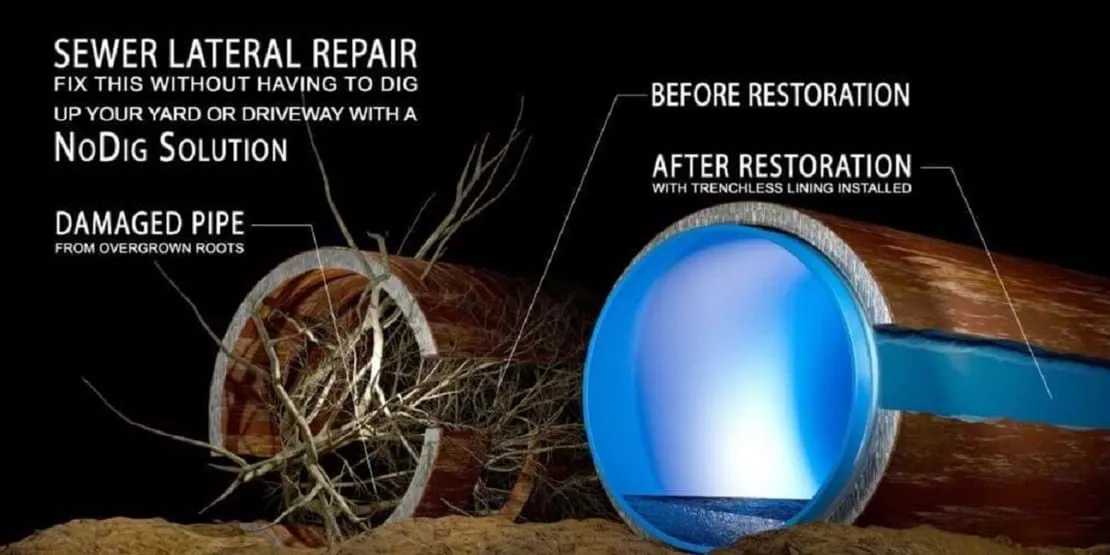
CIPP (cured-in-place pipe) lining is the method most people mean. A felt or fibreglass liner, saturated with resin, is inverted or winched into the pipe from an existing chamber, pressed against the host wall by air or water pressure, then cured until it hardens into a jointless pipe inside the old one. The relevant product standard is BS EN ISO 11296-4. Because it is installed through a manhole or rodding eye, nothing is excavated.
Patch lining — sometimes called localised repair — uses the same resin chemistry over a much shorter length. A short liner is positioned on a packer, inflated over one fracture or open joint, cured, and the packer withdrawn. It is the right tool for a single defect in an otherwise sound pipe, and the wrong tool for a run with a fracture every two metres, where you would end up with a chain of patches and a worse hydraulic profile than a full liner.
Pipe bursting is the outlier. A bursting head is winched through the old pipe, fracturing it outwards into the surrounding ground while dragging a new HDPE pipe in behind. It replaces rather than repairs, and it can go up a size. But it needs a launch pit and a reception pit, so it is trenchless in the sense of "no continuous trench", not in the sense of "no digging at all". Anyone who quotes bursting as fully dig-free is not describing the job accurately.
The defects that can be lined, and the ones that cannot
A liner needs a host pipe with enough shape left to line against. Cracks, fractures, corroded inverts, root ingress and open or slightly displaced joints all line well. Full collapse, severe deformation, missing sections of barrel and heavy back-fall do not. A CCTV survey settles it before anyone quotes.
| Condition found on camera | Usually linable? | Why |
|---|---|---|
| Circumferential or longitudinal fractures | Yes | The barrel is intact enough to support the liner while it cures |
| Open or slightly displaced joints | Yes | A full-length liner bridges every joint at once |
| Root ingress | Yes, after cutting | Roots must be cut back to the wall first, or they are simply sealed in |
| Corroded or eroded invert | Yes | The liner restores a continuous, smooth bore |
| Infiltration through defects | Usually | Running water has to be controlled during cure, which adds time |
| Badly deformed pipe | Often not | The liner takes the shape of what it is pressed against, including the deformity |
| Collapsed or missing barrel | No | There is nothing to line against; excavation or bursting is the answer |
| Standing water from back-fall | No | Lining preserves the existing gradient — a sagging run stays sagging |
That last row is the one people are surprised by, and it is the most important thing on this page. A liner is a new wall, not a new gradient. If the camera shows water standing along a section because the pipe has settled, relining will produce a smooth, watertight pipe that still holds water in exactly the same place. The blockages will come back. In that situation the honest recommendation is to dig and relay the affected length, and we would rather say that at the quoting stage than after you have paid for a liner.
Diameter loss: what a liner costs you in flow capacity
A liner does reduce the bore. On a typical 100 mm domestic drain, a liner a few millimetres thick takes several millimetres off the internal diameter. In practice the loss is usually offset, because the cured liner is far smoother than the tuberculated, scaled or root-scarred clay it replaces.
Hydraulic capacity depends on two things: cross-sectional area and wall roughness. Lining reduces the first and improves the second, often dramatically — an old salt-glazed clay barrel with displaced joints and encrustation offers far more resistance to flow than a continuous resin bore. For most domestic 100 mm and 150 mm foul runs, the net effect is capacity that is unchanged or slightly better after lining.
Where it matters is at the margins: a run that was already undersized for the number of properties on it, a commercial line carrying grease-laden discharge, or a pipe where a thick structural liner has been specified because the host has lost most of its strength. Those are the cases where the wall thickness should be calculated rather than assumed, and where a competent contractor will tell you the finished internal diameter before starting rather than after.
Under a London terrace: access, drag distance and the practical limits
The constraint in most London terraces is not the pipe, it is getting to it. A Victorian terrace typically has no side return and no rear vehicular access, so the liner, the drum and the curing equipment have to come through the house or along the pavement to a chamber at the front — and the drag distance from that chamber sets what is possible.
Across the boroughs this site covers — Barnet, Bexley, Bromley, Croydon, Enfield, Greenwich, Harrow, Havering, Hillingdon, Hounslow, Kingston, Merton, Redbridge, Richmond, Sutton, Waltham Forest and Barking and Dagenham — the housing stock ranges from Victorian and Edwardian terraces on 100 mm salt-glazed clay to interwar semis and post-war estates with shared rear runs. The older stock brings two recurring complications: an interceptor trap at the boundary, which restricts what can be pulled through it, and rear runs that pass under extensions built long after the drain was laid.
Practical limits worth asking about before you accept a quote: how far the liner has to travel from the access point, whether there are bends the liner must negotiate, how many branch connections will need reinstating by cutter afterwards, and whether the drain can be taken out of service for the duration. On a shared rear run serving several houses, that last one means agreeing a window with neighbours, not just with you.
Cure time, and what "back in service today" really means
Curing is the part of the job that cannot be rushed. Ambient-cure resins take the longest, hot water and steam curing are quicker, and UV light curing is quicker again. But cure time is only one component — the drain is out of service from the start of cleaning to the final camera check, not just during the cure.
A realistic sequence on a domestic job runs: pre-clean by jetting, pre-lining CCTV to confirm the pipe is ready, liner impregnation and installation, cure, cool-down, reinstatement of any branch connections with a cutter robot, then a post-lining CCTV survey to confirm the finished bore and record the work. Every one of those steps has to happen before you use the drain normally again.
So "back in service today" is achievable on a straightforward single-run domestic job, and it is a stretch on a long run with several connections to reinstate. The question to ask is not "how long does the cure take" but "from what time to what time can I not use the toilets". A contractor who cannot answer that has not planned the job.
No-dig versus excavation: the honest comparison, including reinstatement
Comparing a liner to a dig on the repair cost alone is misleading in both directions. Excavation carries reinstatement, spoil disposal and often a highway permit; lining carries survey, cleaning, connection reinstatement and a post-works survey. The comparison is only fair when both columns are complete.
What genuinely drives an excavation cost in London: depth to invert, whether the dig is under a driveway, patio, extension or the public highway, spoil removal in a borough with limited on-street loading, and reinstatement to match what was there — block paving and resin-bound drives are considerably more expensive to make good than a lawn. If the excavation falls in the adopted highway you also need a street works licence from the borough highway authority, and the reinstatement has to meet their specification, not yours.
What drives a lining cost: the length being lined, the diameter, the number of branch connections to be reinstated, how much pre-cleaning the pipe needs, access from the nearest chamber, and whether the work has to be done out of hours. Because those variables are so property-specific, we quote from the survey rather than from a price list, and the survey findings are handed over with the quote so you can see what the figure is based on. Current published rates are on our pricing page, and the diagnostic step is described on our CCTV drain survey page.
The reason we lead with no-dig is not that lining is always cheaper. It is that on the majority of the defects we actually find — fractures, open joints, root ingress in an otherwise sound clay barrel — it produces the same structural outcome without removing a driveway. When the camera shows a case where it will not, we say so, quote the dig, and explain why. That distinction is the whole value of surveying before quoting.
Frequently asked questions
Can a collapsed drain be relined?
No. A liner is pressed against the inside of the existing pipe and needs a continuous host barrel to cure against. Where a section has collapsed or is missing entirely, there is nothing to line to. The options are excavation and relay of the failed length, or pipe bursting to pull a new pipe through — both of which require at least a launch and reception pit.
Will relining fix a drain that keeps standing water?
Not on its own. Relining renews the wall of the pipe but follows the existing gradient exactly, so a run that has settled and holds water will still hold water after lining, in the same place. If a CCTV survey shows standing water caused by back-fall rather than by a blockage, the correct repair is to excavate and relay that section to the right fall.
How do I know whether a quote is for full lining or a patch?
Ask for the length being lined and the chainage it starts and ends at, both of which come straight off the survey. A patch covers a single defect over roughly half a metre; a full liner covers a whole run between chambers. The two are priced very differently, so a quote that does not state which one it is has not been specified properly.